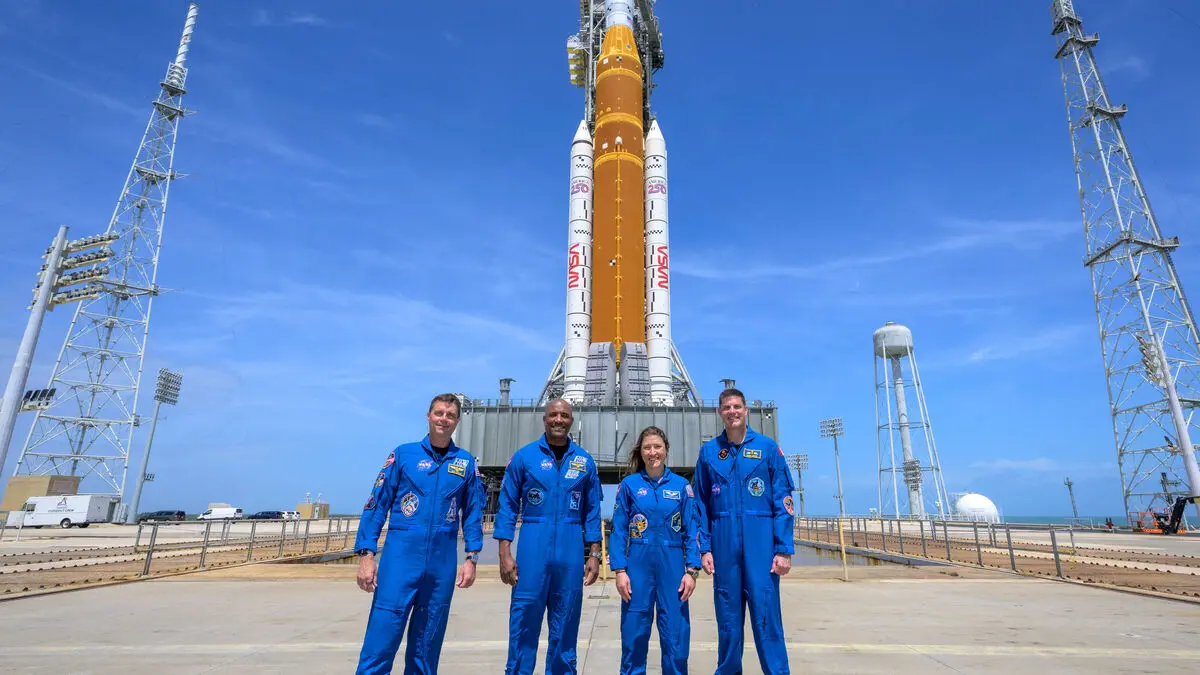
The US space agency NASA is preparing to launch the Orion capsule with four astronauts – three American and one Canadian – as part of the new Space Launch System (SLS) initiative, with the aim of orbit the Moon.
The launch will take place from the Kennedy Space Center in Florida. The first time window for departure begins early Thursday, April 2 at 00:24 local time in Sweden, and the window lasts two hours.
Chance for success
According to Martin Wieser, a researcher at the Institute of Space Physics (IRF) in Kiruna, the chances are good that the rocket will launch on the first attempt.
A lot of people have worked really hard to make this happen, and now it's time to act, he says.
If anything needs to be postponed, there are new opportunities to launch every day up until April 6.
Wieser emphasizes that many things must go right: in addition to the technical systems being in top condition, weather conditions are important.
There must be no clouds that could cause the craft to be struck by lightning, and wind speeds must be within certain parameters.
Ten days' journey
The journey to the Moon will take about four days. When the spacecraft reaches the far side of the Moon, the astronauts will be about 400,000 kilometers from Earth, the furthest humans have ever traveled from our planet.
After the crew passes the far side of the Moon, the return journey will begin. The mission is expected to take around ten days.
Artemis 2 is the first crewed spaceflight in NASA's Artemis program, which aims to take humans back to the Moon and build a space base there, as a launch pad for future trips to Mars.
But the astronauts on board will not land, and the flight can be seen as a test flight, according to Wieser.
The crew will test everything from vehicle navigation to space communications, with the goal of landing on the Moon during upcoming flights planned for 2028.
Increased interest in the Moon
According to Wieser, interest in the Moon has returned since the 2010s, now with players such as India, Japan and, not least, China.
It's a bit like a new space race, and China is definitely a top candidate to land humans on the Moon first.
Even tech billionaire Elon Musk's interest in the Moon has increased.
In February, he stated on X that his space company SpaceX had shifted its focus from building a self-growing city on Mars within 20 years to instead building one on the Moon within ten years.
There are several reasons why humans want to go to the Moon.
In the Moon's polar regions there is ice that can be used to produce oxygen and fuel.
The lunar surface contains metals and other resources that could be important for future space exploration. There are also rare earth elements on the Moon that could be brought back to Earth, as well as an isotope of helium (helium-3) that is extremely rare on Earth. It is a potential fuel for future clean fusion energy.
Scientists also point out that the Moon is a natural testing environment for the next step in space travel.
However, the Moon is a challenging environment, including harmful radiation and fine lunar dust that can wear down equipment.
Traveling to the Moon, and especially landing, is still technically demanding. So far, everything needed must be brought from Earth, including fuel for the entire journey, which places great demands on rockets and systems.
Source: Swedish Space Agency