One might think that war itself is a very direct form of violence, but environmental change may be a slower type of violence, says Gustav Cederlöf, associate professor of environmental social science at the University of Gothenburg.
In the first two weeks alone, the war in Iran caused the emission of five million tonnes of greenhouse gases, according to the Climate and Community Institute, which has analyzed the war's climate impact. That is equivalent to the emissions rate of a medium-sized fossil fuel-intensive country like Kuwait - or the emissions in two weeks from a combined 84 of the countries with the lowest emissions, writes The Guardian .
Buildings and fuel
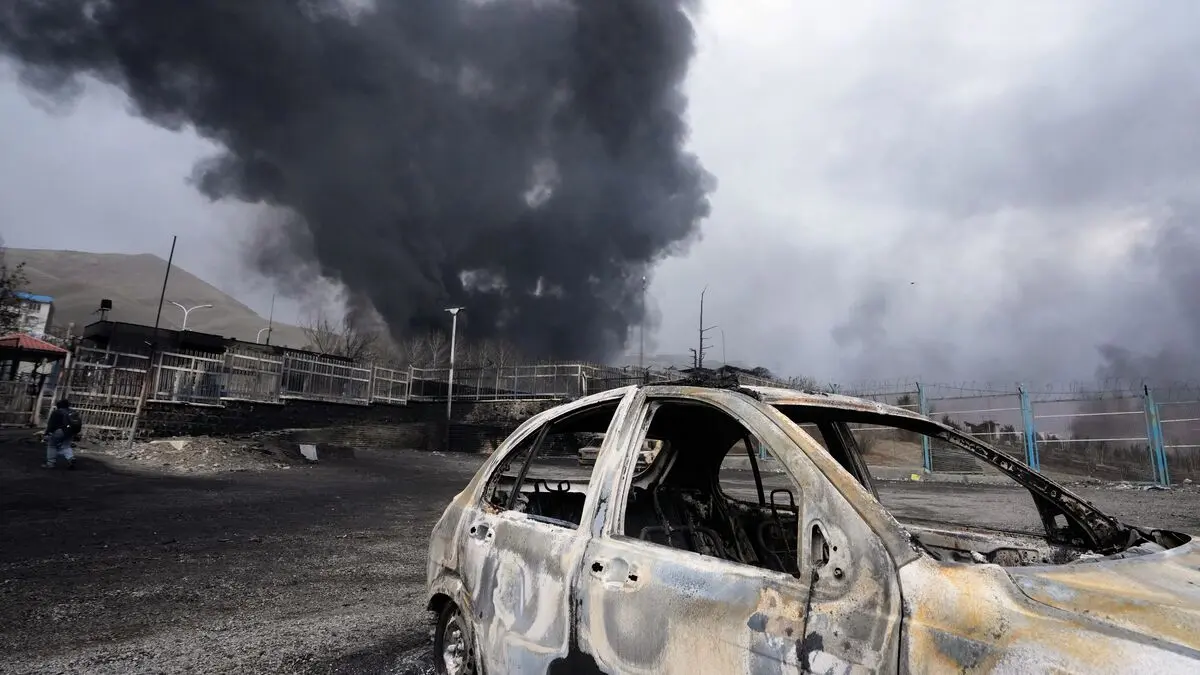
The burning oil facilities that are often seen in pictures are not the worst culprit. Destroyed buildings account for the largest part of the war's estimated carbon cost. According to data from the Iranian Red Crescent, around 20,000 civilian buildings were destroyed in the first two weeks - equivalent to 2.4 million tonnes of carbon dioxide equivalent, according to the analysis.
Heavy fighter aircraft flying long distances, as well as ships and vehicles, are estimated to have contributed 529,000 tonnes of carbon dioxide equivalent.
The analysis from the Climate and Community Institute has included several different factors, explains Gustav Cederlöf.
As a further step, they have also calculated not only the fuel used but also the emissions from producing aircraft and ammunition.
Drone warfare
War affects the environment for a long time to come, and in many cases the effects are difficult to assess. Annica Waleij, senior analyst at the Swedish Defence Research Institute (FOI), discusses the drone war in Ukraine, where downed drones are left lying in fields and pastures, which can have consequences for both agriculture and biodiversity.
The fiber optics that these huge numbers of drones bring with them are affecting birds. These are quite important flyways for migratory birds where a lot of debris ends up and the birds get caught in it.
She still highlights Ukraine as an example.
They have really done a great job there in trying to map out what happened, where it happened, and who can be held responsible at some point in the future.
The Geneva Conventions contain rules that prohibit war tactics that damage the environment in the territory of another state. That increasingly seems to play less of a role, Waleij points out.
You actually shouldn't bomb an oil facility or a power plant. That's a war crime. Yes, it has environmental effects, but the serious thing is perhaps that you are completely ignoring international law - and it protects nature and the environment.
Vietnam
There are still large amounts of mines and unexploded ordnance that both claim human lives and limit land use for agriculture and forestry.
Defoliants, which were used, among other things, to prevent North Vietnamese guerrilla troops from hiding, had far-reaching consequences for animals, people and nature.
Democratic Republic of the Congo
Humanitarian organizations established refugee camps, inside or near national parks. Deforestation to meet the need for firewood is the most obvious environmental impact, which has then led to erosion and landslides during the rainy seasons.
Other problems include hazardous medical waste and household waste that pollutes soil and water.
Kosovo
NATO bombing of industries in Kosovo led to large amounts of chemicals leaking into adjacent waterways and groundwater.
Iraq
Burning oil wells and oil spills have contaminated groundwater. In 2016, Al Mishraq, the world's largest sulfur storage facility, was also set on fire, releasing hazardous emissions over a large geographical area.
Yemen
Repeated attacks on electricity, water and sewage infrastructure have led to the world's largest cholera outbreak. In rural areas, mines and cluster bombs can take a long time to clear, making it difficult to grow food.
Ukraine
Attacks on industries have led to the release of chemicals such as ammonia and nitric acid. The destruction of dams and water reservoirs has flooded industrial and mining areas, resulting in the leakage of chemicals. Troop movements, military installations and the mining of valuable agricultural land have affected the ability to grow crops in what is known as the breadbasket of Europe. The marine environment has also been affected.
Source: FOI