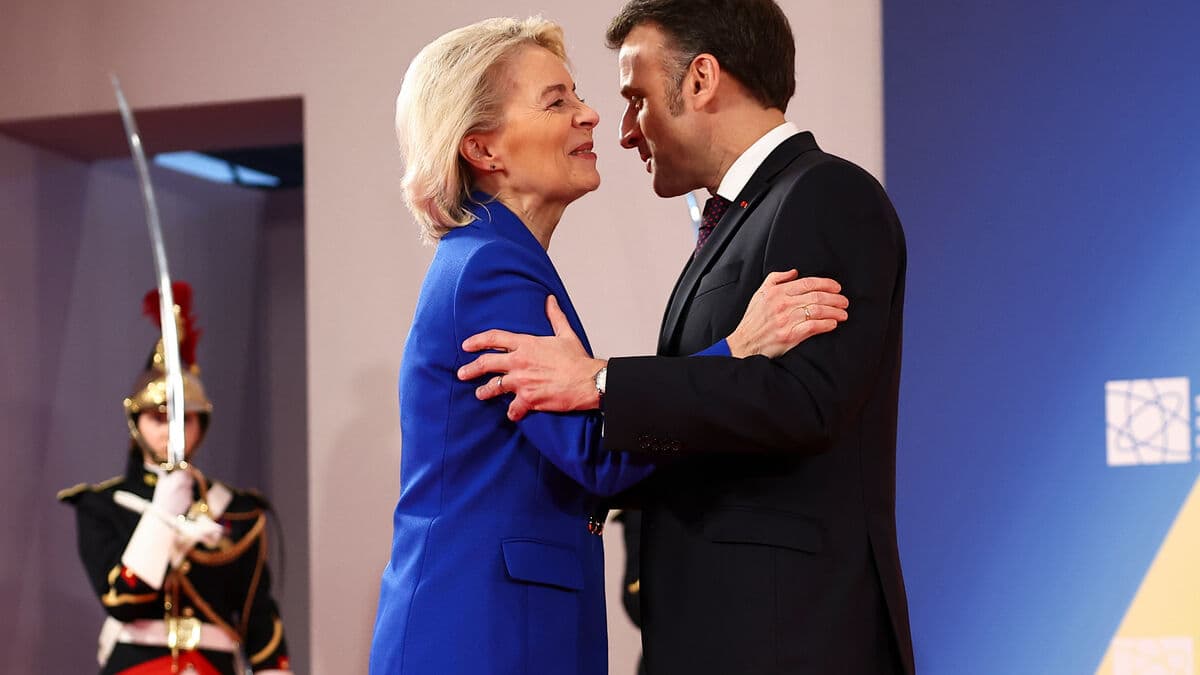
European nuclear power can be an economic success, says von der Leyen in her speech at the International Atomic Energy Agency's nuclear summit in Paris.
The next generation of nuclear reactors could become a valuable European high-tech export, says von der Leyen.
In the speech, she notes, among other things, that nuclear power's share of electricity production in Europe has decreased from one third in 1990 to just 15 percent today.
"In retrospect, we see that it was a strategic mistake for Europe to turn its back on a reliable and affordable source of low-emission power," says von der Leyen.
Small reactors
Her speech is being held at the same time as the Commission has unveiled a new strategy to strengthen the development of small modular reactors (SMRs).
Our goal is very simple: we want this new technology to be operational in Europe from 2030, so that it can play a key role alongside traditional reactors in a flexible, safe and energy-efficient system, says von der Leyen.
In addition to simpler and coordinated permit rules, there is a strong focus on attracting increased investment.
“The race is on”
Among other things, it includes a proposal for a European guarantee of 200 million euros – just over 2.1 billion kronor – to develop “innovative nuclear power technology.” The money will be taken from the emissions trading system (ETS).
We also want to give a clear signal that other investors should join in, says von der Leyen.
The EU still cannot go much further than that in supporting nuclear power. Member states remain strongly divided for and against, which for now makes EU support for new construction or reconstruction impossible.
Tuesday's strategy is still a clear step on the way.
The nuclear race is on. And we know that Europe has what it takes to lead, says Ursula von der Leyen.
Facts: Nuclear power in the EU
Currently, there are nuclear power plants in 12 EU countries: Sweden, Finland, Belgium, the Netherlands, the Czech Republic, Slovakia, France, Spain, Hungary, Slovenia, Romania and Bulgaria. Of these, all except Spain are members of the unofficial so-called "nuclear alliance". Also members are Croatia (which has a nuclear power plant in Slovenia) and Italy (which closed its last nuclear power plant in 1990). Estonia and Poland are observers in the group.
By contrast, Germany (whose last nuclear power plant closed in 2023) has traditionally been the main opponent of EU support and investments in nuclear power, along with Denmark, Austria, Portugal and Luxembourg.