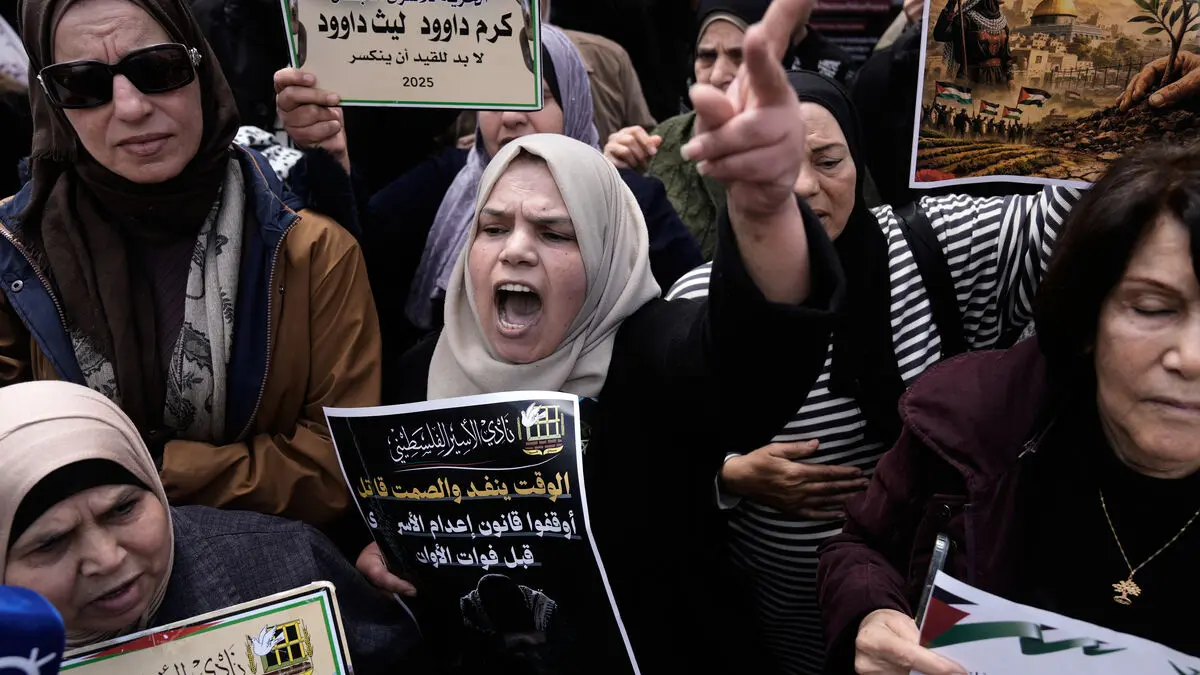
The approval in the Israeli parliament on Monday of a new law introducing the death penalty by hanging has sparked loud protests across the West Bank. “Time is short, silence is deadly,” reads a placard displayed among hundreds of people gathered on the streets of Nablus, reports the AP news agency.
In response to the law, the Fatah party has declared a general strike in the northern West Bank.
In a written statement, the Palestinian Authority (PA) Foreign Ministry in Ramallah said: “The ministry categorically rejects this legislation and considers it a serious and dangerous escalation.”
Furthermore, the PA says the death penalty paves the way for war crimes and institutionalizes "discriminatory and racist positions" that risk collectively punishing the Palestinian people.
Criticism is growing
Criticism also came from Sweden's foreign minister, who declined to say whether Sweden will push for a review of the EU's association agreement with Israel, which contains a clause on respect for human rights.
“I take the developments in Israel very seriously, but I think it is too early to say how it relates to the association agreement,” Malmer Stenergard (M) told TT.
The human rights organization The Association for Civil Rights in Israel (ACRI) has appealed the legislation, which is likely to reach the country's highest court, where it will be revised or stopped.
ACRI, according to the BBC, wrote: "The law is unconstitutional, discriminatory and has been passed without legal basis."
“It’s not justice,” said Pedro Sánchez, Spain's prime minister, who since the Gaza War has been among Israel’s strongest critics in the EU. “It’s a step closer to apartheid,” Sánchez wrote on X.
Britain, Germany, Italy and France have also previously warned against allowing the proposal to become law.
Specific conditions
Israel has had the death penalty for a long time, but it has not been used for decades. The new law includes very specific conditions: it applies to terrorist crimes directed against the state of Israel, which in practice is considered to make it, in principle, applicable only to Palestinians.
Such cases are usually decided in Israeli military courts.